Presentation Evaluation Form Template
A presentation evaluation form is an assessment form used to rate a presentation against criteria such as content relevance, structure, delivery, visual materials, timing, and Q&A handling. It helps teachers, students, trainers, professionals, and event organizers review presentation quality consistently and identify strengths and areas for improvement.
This online evaluation template includes ready-made rating fields and matrix questions, so evaluators can quickly assess both the presentation itself and the presenter’s delivery. The template is short, mobile-friendly, and easy to complete. You can customize the criteria, add your logo, and adjust the design in the AidaForm Builder — no coding needed.
Collect responses securely, share the form by link or embed it on your website, and export results for reporting and analysis as PDF or Excel files.
Below on this page: Steps to use this template · Examples of presentation evaluation questions and criteria
More templates you may find useful
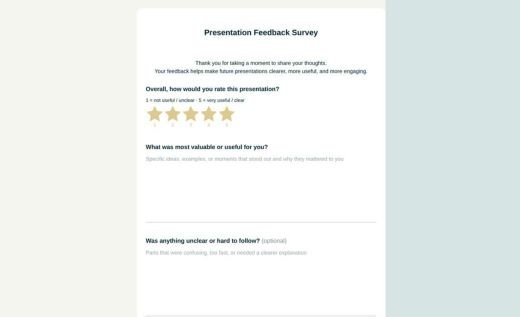
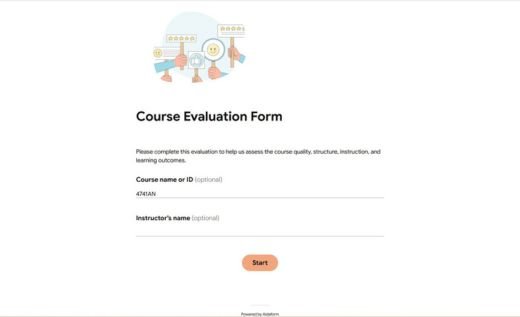
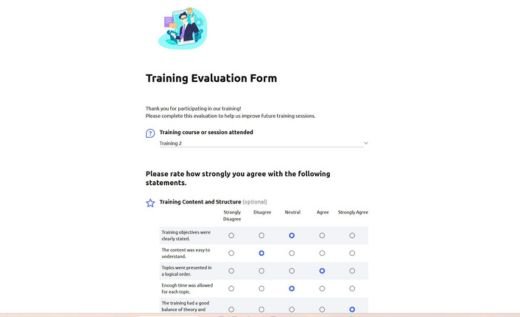
How to edit and publish this presentation evaluation template
Use this template as a starting point, adjust the questions and design to match your evaluation process, then publish it by link or embed it on your website.
Add the template to your AidaForm account
Use this form sample as a starting point for your own presentation evaluation form, or publish and share it as it is. Click the Use This Template button, and the template will appear in your AidaForm account, ready for editing. If you see a registration form instead of the editor, log in or create a free account. It only takes a minute and gives you access to form fields, design tools, response storage, statistics, and other features.
Edit questions and structure
Open the form to adjust the content. Edit titles and questions, remove anything you don’t need, and add page breaks if you want to split the form into steps. Use evaluation elements such as ratings, scales, and matrices — all available in the Form Elements tab. Matrices are a great option for presentation evaluation forms because they group similar criteria neatly and keep the layout tidy.
Personalize the design
To add branding, open the Form Designer tab. Choose a preset color scheme or set your own colors, pick fonts, adjust button styles, and change the form size. Upload your logo and use the Preview button to check the design as you go.
Publish, share, and collect responses
While you edit, the form is not visible to others. To make it accessible, open the Publish tab and switch the status. Then you can share the form by link, embed it on your website, track statistics, and collect responses. Your form stays editable, so you can reuse it for future presentations.
Presentation evaluation questions and criteria
A good presentation evaluation form usually includes an overall rating, criteria for content, structure, and presenter delivery, plus optional open-ended fields for strengths and areas for improvement.
Below, you’ll find practical examples based on proven evaluation practices. Copy and paste them into your form, or adjust them to match your evaluation process.
Introduction questions
Start with a short note on what the evaluator should do and how long the form will take. It is also helpful to explain the purpose of the form and how the data will be used or stored.
For example:
Please take a few minutes to evaluate the presentation. Your assessment will help identify the presenter’s strengths and areas for improvement. The form takes about 3 minutes to complete. Responses will be stored securely and used only for evaluation and improvement purposes.
You can also add a few optional fields to identify the presentation and evaluation context:
- Select the presentation you are evaluating.
Recommended field: Dropdown - Who is the presenter?
Recommended field: Short text field - What is the presentation topic?
Recommended field: Short text field - Which best describes your role as evaluator?
Recommended field: Multiple choice
Answer options: Instructor / Student or peer / Manager / Reviewer / Audience member / Other - Class, course, event, or organization name
Recommended field: Short text field
Overall evaluation questions
Use one or two general questions to summarize the evaluator’s overall assessment. These questions work well before or after the detailed rating criteria.
- Overall rating
Recommended field: Star rating, slider, or rating scale
Suggested scale: 1 — Poor, 5 — Excellent - Did the presentation meet its objective?
Recommended field: Multiple choice
Answer options: Yes / Partly / No / Not sure - Was the presentation appropriate for the audience?
Recommended field: Multiple choice
Answer options: Yes / Partly / No / Not sure
Presentation content and structure criteria
Use criteria to evaluate the presentation itself: the material, organization, logic, examples, and supporting resources. The following criteria are suitable for most presentation types, including student presentations, oral presentations, training sessions, webinars, pitch presentations, and professional talks.
- Content relevance
- Clarity of main message
- Logical structure
- Supporting examples or evidence
- Visual materials
Recommended field: Matrix
Suggested scale: Very Poor / Poor / Fair / Good / Excellent
Presenter delivery and interaction criteria
Use criteria to evaluate how the presenter communicates, manages time, and interacts with the audience.
- Speaking clarity
- Confidence and preparedness
- Audience engagement
- Time management
- Q&A handling
Recommended field: Matrix
Suggested scale: Very Poor / Poor / Fair / Good / Excellent
Criteria and questions for specific presentation types
You can add a few extra criteria based on your evaluation context. Avoid adding too many items: a shorter form is easier to complete and usually produces better-quality evaluations.
For a student presentation evaluation, you may add:
- Understanding of the topic
Recommended field: Matrix criterion or rating scale - Use of sources or research
Recommended field: Matrix criterion or rating scale - Fulfillment of assignment requirements
Recommended field: Matrix criterion or rating scale
For a peer presentation evaluation, you may add:
- The presenter explained the topic in a way peers could understand.
Recommended field: Agreement scale - The presenter’s work showed clear preparation.
Recommended field: Agreement scale - What is one specific suggestion you would give the presenter?
Recommended field: Long text field
For an oral presentation evaluation, you may add:
- Voice and pace
Recommended field: Matrix criterion or rating scale - Eye contact and body language
Recommended field: Matrix criterion or rating scale - Confidence and limited reliance on notes
Recommended field: Matrix criterion or rating scale
For a professional presentation evaluation, you may add:
- Business relevance
Recommended field: Matrix criterion or rating scale - Quality of data, examples, or recommendations
Recommended field: Matrix criterion or rating scale - Practical value for the audience
Recommended field: Matrix criterion or rating scale
Open-ended evaluator comments
Structured criteria help evaluators score the presentation consistently, but open-ended fields let them explain the reasons behind their ratings. Add one or two comment fields at the end of the form.
- What were the presenter’s key strengths?
Recommended field: Long text field - What could be improved?
Recommended field: Long text field - Do you have any additional evaluator comments?
Recommended field: Long text field
For a short presentation evaluation form, one combined comment field is usually enough:
- What were the presenter’s key strengths? What could be improved?
Recommended field: Long text field
Thank you message
End the form with a short confirmation message.
For example:
Thank you for completing this presentation evaluation. Your assessment has been submitted.