Course Evaluation Form Template
A course evaluation form is a questionnaire used to assess how well a course is designed, delivered, and understood by students. Schools, universities, and other education teams use it to collect student ratings, review course quality, compare results across groups or semesters, and make evidence-based improvements.
This expert-designed AidaForm course evaluation template is a complete, ready-to-use evaluation tool. It guides students through the main evaluation areas — course content, practical value, instructor performance, and access to learning materials — using statement-based matrix questions. Students rate clear statements on an agree/disagree scale, which keeps answers consistent and gives you data that is easier to compare. The template also includes an overall course score, a final open comment field, and a progress bar that shows students how much is left.
Add the template to the AidaForm builder and customize the evaluation criteria, rating scales, text, and design. You can share the form by link or embed it on a website page — no coding required.
Below on this page: Steps to use this template Course evaluation question examples FAQ
More templates you may find useful
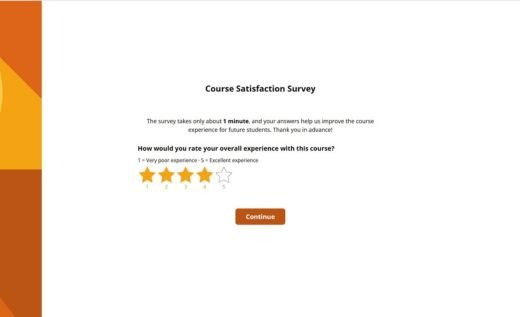
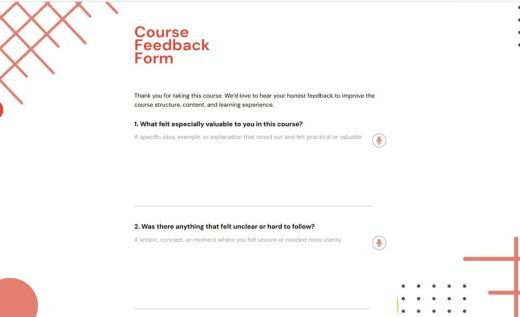
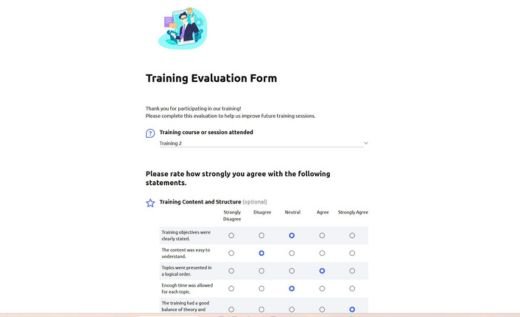
How to use this course evaluation template
Add the template to your AidaForm account
Click Use This Template to copy the course evaluation form to your AidaForm account. If you do not have an account yet, you can create one during this step.
Edit the questions
Open the form in the Form Builder to change the evaluation criteria, rating scales, section names, and final comment field. Keep the ready-made structure as it is, or adapt it to your course format and reporting needs.
Customize the design
Use the Form Designer menu to adjust colors, fonts, buttons, and layout. You can also add your logo to match your school, university, or education program branding.
Publish and share the form
Go to the Publish tab to make the form available online. Share it with students by link or embed it on a website page. Responses are collected in your AidaForm account, so you can review ratings and compare results after the evaluation is complete.
Course evaluation question examples and what they measure
A strong course evaluation survey uses clear, single-purpose criteria, so students understand what they are rating and you know what each score means. Instead of mixing all questions into one long rating list, group them by topic: course design, practical value, teaching, delivery conditions, and overall evaluation. This makes the results easier to read and shows where changes are needed.
A recommended format for course evaluations is statement-based matrix questions. Students rate clear criteria on the same agreement scale, which keeps answers consistent and makes section scores easier to compare.
Standard scale example:
Strongly Disagree · Disagree · Neutral · Agree · Strongly Agree
Course content and organization
Start with these questions because they evaluate the foundation of the course: clear objectives, logical topic order, appropriate pace and difficulty, enough practice, and useful materials. This section shows whether the course itself is well designed before you move on to instructor performance or course access.
Example statements:
- The course objectives were clearly defined.
- The course content matched the stated objectives.
- Topics were organized in a logical order.
- The course pace was appropriate.
- The level of difficulty was appropriate.
- The course included enough examples or practice.
- Course materials and resources were useful.
Practical value
This section measures what students gained from the course. Use these questions to understand whether the course helped students build knowledge, develop skills, and see a clear connection between the course and their goals.
Example statements:
- The course helped me improve my knowledge or skills.
- I can apply what I learned in practice.
- The course was relevant to my goals or needs.
Instructor performance
Keep instructor questions separate from course content questions. This makes it easier to understand whether lower scores are connected to the course design itself or to how the course was delivered.
Example statements:
- The instructor demonstrated strong knowledge of the subject.
- The instructor explained concepts clearly.
- The instructor managed lesson time effectively.
- The instructor answered questions clearly.
- The instructor supported student learning.
Course format and access
Use this section to check whether students had the right conditions to complete the course. These questions cover access, tools, materials, communication, and technical or organizational barriers.
Example statements:
- The learning platform, classroom, or course access worked well.
- Required tools or equipment were available.
- Course materials were easy to access.
- Communication about schedule, requirements, and updates was clear.
- Technical or organizational issues did not interfere with learning.
Overall evaluation and comments
Finish with one overall score and one open comment field. The score gives you a simple result to compare across course groups, semesters, or course versions. The comment field gives students space to add criticism, suggestions, or context that did not fit into the rating sections.
Example questions:
- Overall, how would you rate this course?
1 = Very Poor · 5 = Excellent - Do you have any comments, criticism, or suggestions about this course?
Course evaluation FAQ
What is a course evaluation form?
A course evaluation form is a questionnaire used to review a course through clear, criteria-based questions. It helps collect student ratings on areas such as course content, organization, instructor performance, practical value, access to materials, and overall course quality.
What should a course evaluation form include?
A good course evaluation form should include the course name or ID, instructor name, rating sections grouped by topic, one overall course score, and an open comment field. For reliable results, avoid asking only general questions. Group the criteria by topic so you can see whether lower ratings come from content, teaching, course access, materials, or practical value.
What is the difference between course evaluation and course feedback forms?
A course evaluation form focuses on criteria-based ratings and comparable results. It is used to assess a course against specific criteria in a more formal and structured way.
A course feedback form focuses on students’ opinions and suggestions in their own words. It is used to collect ideas, criticism, impressions, and improvement suggestions through more open-ended questions.
When should I send a course evaluation form?
Most course evaluation forms are sent near the end of a course or shortly after completion, while the learning experience is still fresh. For longer courses, you can also send a shorter mid-course evaluation to identify problems early and make adjustments before the course ends.